Showing posts with label Powered by Radiator. Show all posts

Thursday, January 6, 2022

Radiator Auth.fi: easy and secure Wi-Fi Authentication for your organization

Organizations using Wi-Fi networks need an easy and secure way to provide access to the network, either to their own users or guests. At Radiator Software, we have been working with many use cases around this theme and we wanted to provide a solution where authentication features of Radiator can be used as easily as possible.

For this use, we created Radiator Auth.fi.

Radiator Auth.fi is a RADIUS based Wi-Fi authentication cloud service for network users and guests. It provides an easy way for employees or subcontractors to get self-service network access credentials for WPA2/WPA3 Enterprise secured network. It can also be easily deployed: you do not need new hardware, but only a few changes to the settings of your current network devices.

Radiator Auth.fi can be used globally from different locations. To accomplish this, we have set up a global cloud service that can cover multiple locations, while making sure that the service is GDPR compliant.

In addition, Radiator Auth.fi supports Wi-Fi roaming. If the visited organization and networks are part of the same roaming federation (such as eduroam or govroam) that is supported by the service, and roaming access is permitted, the roaming user’s device signs in to the network automatically and safely. It uses the settings and user credentials that are already stored in the user device.

Would you like to know more?

For more info about Radiator Auth.fi, please contact our sales team at sales(a)radiatorsoftware.com. We are happy to discuss your use case and how Radiator Auth.fi may suit your needs. Commercially, Radiator Auth.fi is based on a flexible, pay-as-you-go subscription model that allows you to scale the use of the service based on your business needs.

Monday, January 15, 2018

Radiator use case: Secure authentication to network devices in corporate network

Radiator AAA Server Software has countless use cases in enterprises. This blog text introduces you a specific use case of real life: authentication of network administrators who configure and maintain corporate network infrastructure. This requires extra security that Radiator is able to provide.


In the example use case, the admins log in to Broadband Network Gateways (BNG) with TACACS+ protocol using their own authentication credentials and passwords. For essential network equipment, a secure two-factor authentication (2FA) is used. Radiator supports a wide range of interfaces for these kinds of authentication use cases. Our customers are free to choose the interfaces and protocols that suit to their own needs.

LDAP user database provides the first factor authentication in the example use case. The second factor is handled by Duo Security.

With AuthBy DUO module, you can configure Radiator to integrate with Duo Security API, which in this case provides the second phase of authentication with Duo Security’s phone application. After the authentication has been confirmed by the application, Radiator will grant access to the network.

Using different 2FA solutions

In addition to TACACS+ protocol, Radiator supports wide range of different authentication protocols that you can use – including RADIUS. It is also possible to use different methods for the first factor authentication and second factor authentication. Radiator supports a number of interfaces suitable for the second factor authentication, and we already have use cases with several different solutions. These interfaces are included in Radiator licences.

If you have any needs for two-factor authentication in your own network, please contact our team at info@radiatorsoftware.com. We are happy to share our experience and help you with your own project.

Updated 6th of February 2018:

You can also learn more about the technical architecture from our earlier post: Secure your network and services with Radiator two-factor authentication.

Monday, December 7, 2015

Powered by Radiator: Verkkovieras.fi for simple and secure federated Wi-Fi authentication

Powered by Radiator: Verkkovieras.fi


This blog post is first one of the Powered by Radiator articles, where we and our agents or partners introduce products, services or solutions they have made using Radiator. If you have a product, service or solution you would like to introduce, please contact sales (a.t.) radiatorsoftware.com for more information.

This time it's Arch Red's turn to introduce their cloud based authentication service -- verkkovieras.fi , Powered by Radiator.

verkkovieras.fi for simple and secure federated Wi-Fi authentication

David Bleasdale: security
Verkkovieras is a Finnish word, which means network guest. Verkkovieras.fi is Arch Red's cloud authentication service for organisation’s employee and guest network access control. The service also supports authentication roaming federations such as eduroam and roam.fi making the service an easy way to deploy and serve federated network access for employees, guests and partners.

We know that maintaining user databases and RADIUS servers for employee and guest access can be difficult, especially when there’s additional complexity such as federated roaming. With verkkovieras.fi we focused in building a service, which is easy to deploy and easy to use. We thought, designed, thought some more and improved our design to be as clean and clear as possible.

Easily deployed in any Wi-Fi network

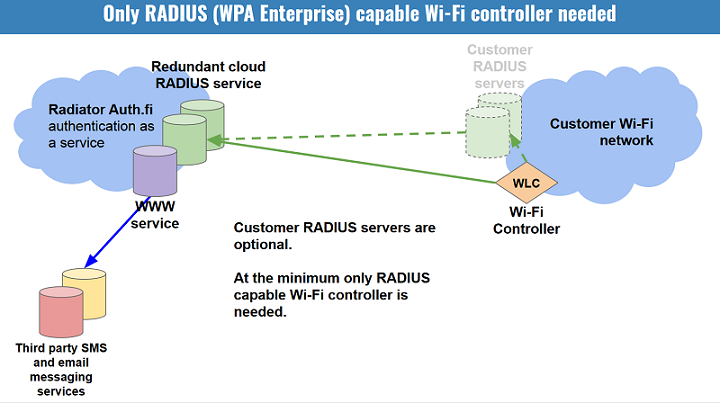
To deploy verkkovieras.fi authenticaton service you only need RADIUS capable authenticated devices such as for example almost all Wi-Fi controllers and access points. The authenticating device, usually the Wi-Fi controller, needs to be able to communicate with our cloud based servers in Internet and that’s it -- only our server details and Wi-Fi networks need to be configured in the controller.

User account registration as easy as email


Employees manage their user accounts themselves by requesting them from WWW page and after simple email-www page confirmation they activate their email address based user account. Account’s username is their email address and password is randomly generated string. We wanted to make sure that the network password is secure and on the other hand create a separate user account for network access. This was to keep more important or sensitive passwords such as Active Directory or other service passwords separate and safe. This way the employee cannot undermine the security by changing password to less secure or more sensitive one.

Federated roaming with a flick of a switch


Roaming federations and federated user access is even simpler, just select which federations and to activate or deactivate it. Your employees or visiting roaming guests are then able to roam free within federations and networks with same profiles they use for network access in your home network.

Easy guest user access or traditional vouchers -- you choose

Howard Lake: Sainsburys Active Kids vouchers
For guest user access there are two options, a simple time-limited guest user account for automated access and possibility to create and print more traditional time-limited guest user accounts before hand. Automated access means that the user account can be integrated for example with WWW page based authentication to provide guest short Internet access with just a click of a button on the authentication page. The traditional guest user accounts can be used like vouchers, the username and password must be entered on the authentication page or system dialog to get the access to network.

All this as a cloud service, ready to be deployed today

verkkovieras.fi architecture

We packaged all this in a redundant Amazon cloud based service distributed across two geographical regions, where we handle the difficult details such as scaling, server certificates, EAP methods (EAP-PEAP, EAP-TTLS, EAP-PWD) leaving you as a customer time to focus to your business and core functions.

If you are interested, contact our sales team: sales (a.t.) archred.com for more details.