Showing posts with label radius server. Show all posts

Tuesday, October 5, 2021

Radiator and NCINGA - working together towards customer success


While Radiator has hundreds of operator customers all over the world, we also have an extensive network of integrator partners providing turn-key solutions for our customers. One of these trusted integrators is NCINGA.  As NCINGA is known to provide technology transformations in frontier markets, they also provide Radiator AAA solutions to operators and carriers especially in the APAC area.

This collaboration has provided solutions to customers both for fixed and wireless AAA. In
different use cases, the main focus in the cooperation has involved integrating Radiator
solutions with different vendor environments and network elements. Radiator is used for
example when applying policy and control functionalities for end user data plans.

    “With Radiator, we were able to quickly deliver complex AAA implementations. It was easy
    to configure and extend to the customers need. The Radiator Technical Support team made
    it even easier to implement & support with prompt responses and guidance.” 

    -Kokum Randeni, VP Sales, Ncinga

One of the key elements in the working model has been the flexibility in Radiator licensing:
the components needed by the customer can be tailored to the use case and number of
subscribers. This way the ROI for the customer can be ensured as they can add new
features of Radiator to use when needed.

For the customer, the operating model is quite easy and straightforward: NCINGA and their
team of experts provide the first level support and integration consultation, and the Radiator
team provides the product-related 2nd level support and consultation related to Radiator
specific configuration and other needs.

Would you like to know more about Radiator and NCINGA?

If you are looking for a carrier-grade AAA server with flexible options for different use cases,
please do not hesitate to contact our sales team at sales(a)radiatorsoftware.com. For
NCINGA, please contact their sales team at www.ncinga.net.


Examples of Radiator use include carrier-grade AAA, Wi-Fi offloading, integrating Diameter
online and offline charging with RADIUS-based infrastructure, integrating RADIUS
accounting with Diameter online and offline charging and much more. On top of that, our
support team has wide experience of various carrier use cases in different environments.
Tuesday, May 22, 2018

RAdmin version 1.16 is released

We are pleased to announce that RAdmin version 1.16 is now released. RAdmin is our tool for managing RADIUS users. With RAdmin you can check usage summaries, drill down to usage details and much more that is needed when managing your RADIUS traffic and users.

For this revision, we have implemented one key security fix, multiple bug fixes and and other enhancements. With 2-factor authentication, for example, support for using Yubikey 2-factor authentication tokens has now been updated. This release allows our customers to be sure that the software we provide is up-to-date and can be run on the current Windows, Linux and other platforms. 

For detailed list of enhancements, please see RAdmin revision history. 

New features

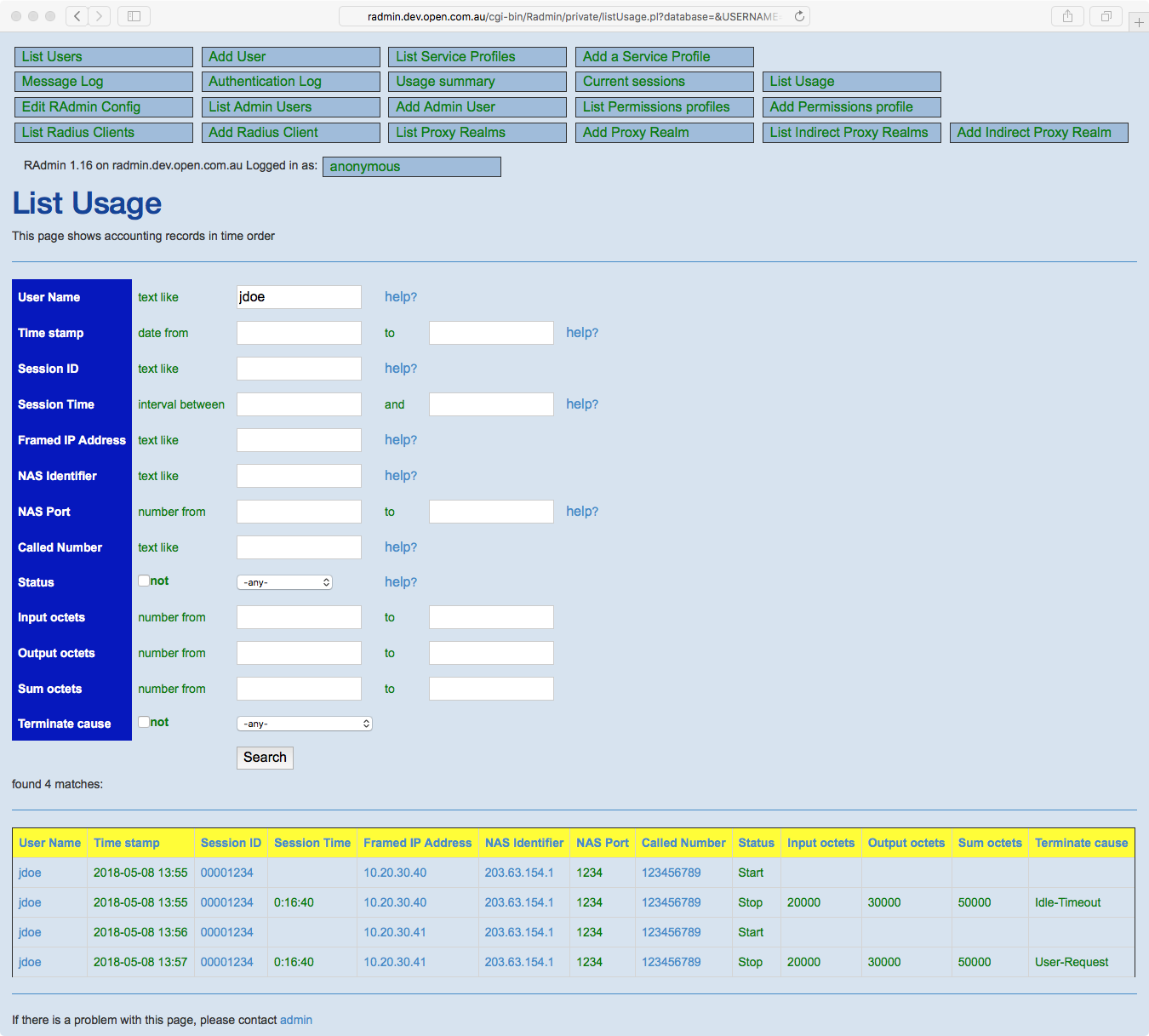
In addition of providing new bugfixes, version 1.16 also provides new enhancements for RAdmin UI. One example of these is providing a better way to listing usage of different users and sessions (see picture below). In addition other new usability and UI fixes are now available in order to provide a user-friendly way for managing network users.


Would you like to know more?

We are happy to provide RAdmin, like other Radiator products for evaluation.

RAdmin is designed especially for ISPs, CSPs and other companies or organizations that have the need to manage their RADIUS users. When contacting our sales team at info@radiatorsoftware.com we are happy to provide more info about use cases for Radiator and RAdmin. 

Thursday, August 20, 2015

SIM Authentication and Charging with Radiator - expand your data coverage with Wifi

In many cases operators and telcos have a need to expand their mobile data coverage with Wi-Fi. In many cases, the main requirements common to many network service providers are:


  1. One authentication method need for both Wi-Fi- and LTE-networks. This way the authentication and charging of clients would be easy no matter which network the client uses.
  2. Both mobile and laptop users need to have common charging and policy method


In addition to this, common requirement is to provide prepaid data plans for their clients. The clients must not exceed the prepaid plan, no matter which device they use or how they authenticate.


The solution - SIM Authentication, Policy and Charging control with Radiator.


Our solution for our customers behind this is Radiator EAP-AKA - a standard for authenticating wireless LAN access with SIM cards and the existing worldwide 3G/LTE mobile network. Support for EAP-AKA is now included in a number of smart phones, tablets and other devices. In addition to this, laptop users can use the same authentication service with username/password (PEAP) authentication.


In order to provide additional requirement for our customers, how to provide a prepaid data plan for their clients, we used another Radiator server with charging and policy functionality.


One of the perks include novel functionality for the end user when his data quota has been used. End user is not logged off from the network at any time - for example during the session when rest of the data quota is used. However, when end user tries to log on next time after the quota has been used, his network access speed is restricted only to support renewal of data plan.

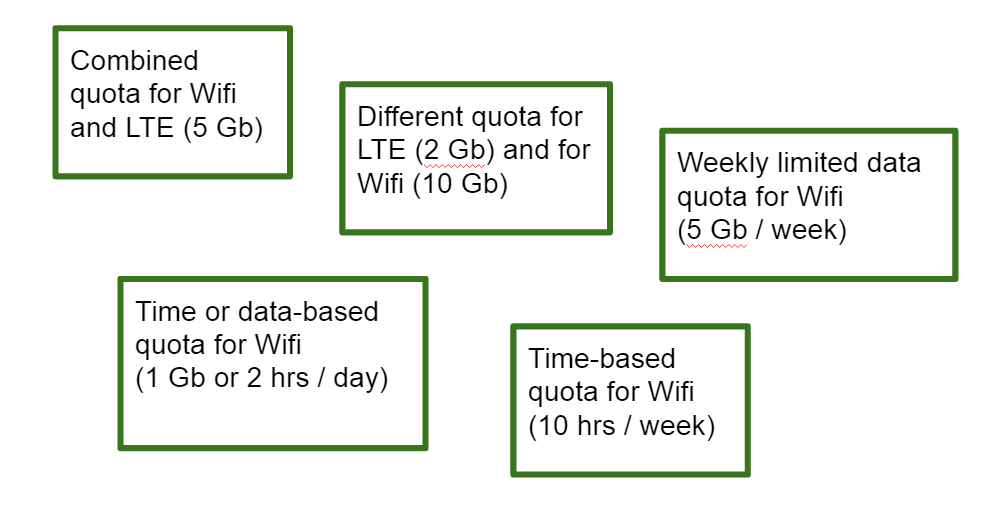
This solution provides flexibility for data plans of end users - whether you want to provide them access based on data quota, time spent your network, or both.


Examples of different data plans for different customer needs - all can be done with Radiator


How we did it?


During the configuration process, our experts have been working side by side with customers' personnel, to provide support where needed. Together with our customers, mostly telcos, we have been creating solutions in which Wifi- and LTE-networks can be authenticated with single SIM. With this kind of solution, both the Wifi- and LTE-networks use the same data plan. Our expert team is happy to help you in this kind of configuration and integration projects - solutions can be done in various network vendor environments.

Same need in your own network?

The right solution for your needs is Radiator EAP-SIM Pack, Radiator Policy and Charging Support or combination of these two. Please contact our sales team for more info: sales (a.t.) radiatorsoftware.com with your plans.

Radiator EAP-SIM Pack is now known as Radiator SIM Pack.

Thursday, July 16, 2015

Radiator version 4.15 released!

We are pleased to announce that Radiator version 4.15 is now released! As always, a new version contains a new set of features for even better Radiator performance. These include:

  • Support for Gossip when communicating next hop proxy failures between Radiator instances
  • Shared duplicate cache for a more simple server farm configuration 
  • Windows Event log support 
  • Custom format support for logs, authentication logs and accounting logs. CEF and JSON included
  • And many things more, please see Radiator revision history
Interested in Radiator?

Please contact our sales team at sales (a.t.) radiatorsoftware.com

Tuesday, June 9, 2015

Radiator logging features - have a better understanding of your network

A proper logbook keeps the world in order. Photo by vxla.

As networks are the most business critical components of telco and ISP business, it is important to know what is happening on them. For this the network needs AAA and SIEM (Security information and event management) services. The SIEM services are often provided by different vendors with different requirements for message format. For example, some use CEF while the others can accept free format text. We are proud that Radiator already provides interoperability that our customers can rely on. We also welcome your requests for new features.

Radiator 4.14 introduces LogFormatHook that provides a new way to handle logs. The main use of LogFormatHook is to create Radiator logs in different formats such as JSON and CEF. After this the formatted log message can be transmitted to an external log server or SIEM system for further processing, visualisation and archiving. Examples of these servers and systems are Splunk, Elasticsearch and RSA enVision and Security Analytics.

Especially with SIEM systems this functionality provides Radiator users many opportunities for log analysis. The SIEM systems can process log data for forensic analysis, compliance, dashboards and alerting - everything you or your customers need to know about status of their network.

Considering updates to your logging configuration?

If you have a network environment that needs this kind of interoperability with their log or SIEM systems, please contact our sales team at sales (a.t.) radiatorsoftware.com . Also, if you have questions about interoperability concerning Radiator or some other AAA server solution - we just may have a solution for you.

Friday, May 22, 2015

Reduce the time to market of your products with Radiator

 
Photo by Egan Snow

Time to market is one of the key issues when you want to provide new services and products to your customers. When competition is though, new ideas should be easy implement in your customer’s operating environment.

One of the strengths of Radiator charging and policy pack is its flexibility in order to test and create new products. As a policy controller, Radiator is often much more flexible than many options on the market.

Flexibility for authentication or database testing

One example of this flexibility are the SIM cards that can be used to create and fully test new products.  In some of our projects, our customers have at first used the dedicated Radiator SIM cards (available freely from us) before switching over to the production environment. Piloting the customer experience for SIM authentication was made as realistic as it gets.

And it doesn't end here: in a similar way telcos or other operators can first test their new services, for example, new data plans, in a safe environment before going live.

Another example where flexibility comes in handy are the different types of databases. Since Radiator Policy charging and rules function (PCRF) and Online charging system (OCS) have been tested against sqlite, MySQL, PostgreSQL and Oracle SQL Database, it is possible for you or your customer to choose from different options that fit best to your needs and existing environments and the data within.

How to speed up your product and service development with Radiator?

Our team has gained experience with Radiator for different use cases over multiple years. We have wide experience of different kind of product solutions. When you are thinking about use cases, such as SIM authentication or policy and charging issues, please do not hesitate to contact our sales team at sales@open.com.au

Friday, May 8, 2015

Radiator Connects - from Machine to Machine to the Internet of Things

Our customer, a telecommunication company, had a pressing need in their network. They needed to replace their outdated Radius solution with a new design that allowed their M2M (Machine-to-Machine) network to function automatically as a integrating solution between the network controlled devices and the operator’s network.

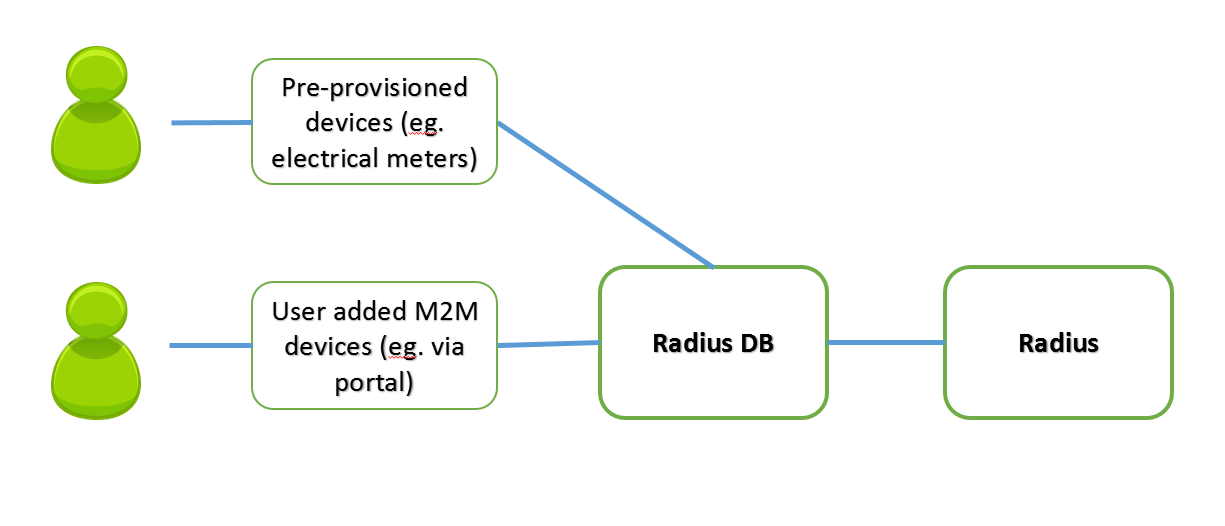
In addition to telcos, the same kind of solution can be provided for power companies, logistical companies and others who have a need for an IoT-solution where devices interact with each other. Devices can be either pre-provisioned in batches (such as contactless electricity meters) or they can be uploaded to the system one device at a time via the user portal operated by the company. The basic functionality is shown below.


In this kind of operating environment, it is essential that the Radius server used for authentication and provisioning is compatible with and able to adapt different systems and devices - some dated while back. You may have, for example, a need to use database of some specific vendor (Oracle etc) in the future as well. From Radius server you then need interoperability and flexibility - and Radiator can be easily integrated to your operating environment. 


Same need in your own network?

For this kind of configuration, the right solution for you is Radiator, possibly with Radiator EAP-SIM Pack  - with an IoT-solution it is often convenient to use SIM authentication. To complement Radiator capabilities, our team of Radiator experts, making it easy for you to just deploy Radiator as the solution or the replacement for less flexible system. Please contact our sales team sales@radiatorsoftware.com,  when figuring out the best solution for your needs.


The Radiator EAP-SIM Pack is now known as Radiator SIM Pack.

Wednesday, May 6, 2015

Preventing Bill Shock with Radiator

Photo by Thomas Fano
Unexpected bill shock - a huge bill accumulated from roaming - can be a nasty surprise for your customers. It is also one that can be avoided, both in domestic and in global use. One of the most known use cases is based on EU roaming regulations.

When your client uses mobile phone in other EU countries to go online, there's a limit on what an operator can charge them. The limit is based on EU regulations. To protect the client against excessive data roaming bills, the monthly cost of downloaded data on mobile device is capped, worldwide, at €50, unless something else has been agreed on. Following the EU regulations, a warning is sent when the usage reaches 80 % of the quota.

In addition to EU regulations, a system for warning and limiting data use is needed for global roaming to ensure that your clients will not have a bill shock from their worldwide data usage.

With Radiator, we have already done these kind of solutions for our operator customers who have in turn provided it for their virtual operators. In this post, we will tell you how to do it.

How to use Radiator to prevent Bill Shock

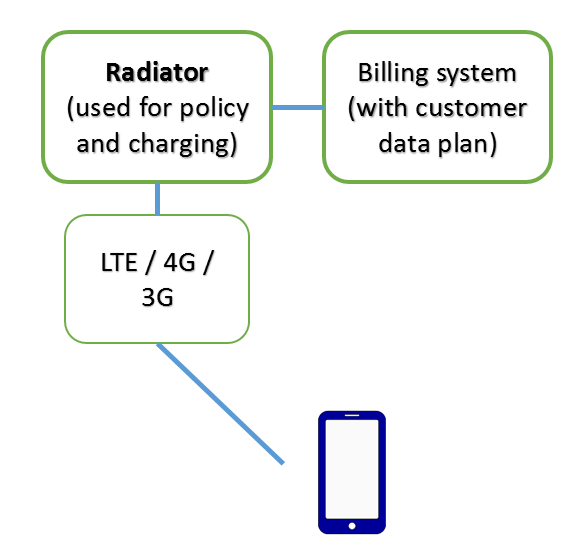
The basic layout of operator infrastructure

Radiator keeps track on the data used by the customer. To do so, Radiator interacts with the billing system where the data plans and client information is stored.

Customer's SIM is used to lookup information about the customer’s current quota usage, data plan, phone number for SMS alerts and possible other information, such as custom limit for data usage. One data plan is typically used for most of the customers, another for enterprise customers and another for customers of a virtual operator.

The client’s updated quota is then stored in the database. When the quota limit is reached, an automated SMS message is sent to the customer. After each month, the data quota is reset in the database and the usage monitoring will start from the beginning.

Customers are happy when their roaming quota is monitored reliably, and operator does not have to allocate any resources to this task. 

What do you need?

The functionality can be done with Radiator Policy and Charging Support. Contact our sales team at sales (a.t) radiatorsoftware.com.

Wednesday, August 13, 2014

Welcome to the Radiator AAA Server Cookbook


Radiator RADIUS server has been around since the early days of Internet service providers. It has and is still been developed together with our customers and partners around the world. In fact, during its lifetime, so much additional functionality and protocols have been added to Radiator, that instead of just RADIUS server, we should talk more about Radiator AAA (Authentication, Authorisation and Accounting) server. Our new extension packs, Radiator SIM Pack and Radiator Diameter Pack, extend Radiator far beyond of just RADIUS and TACACS protocol functionality. Radiator runs and scales from small embedded devices like Raspberry Pi to carrier grade network equipment and server platforms including Linux, UNIX(-like) and Windows server platforms. Radiator can be run on actual hardware or virtualised in the cloud, the major design point being that Radiator is flexible, scalable and interoperable for customers and integrators to be used everywhere in the AAA infrastructure.

The challenge in marketing Radiator is that because it can do almost everything, where should and could we start in describing what the Radiator can be used for. In trade fairs it is always possible to ask the visitors what does their organisation do and then select a suitable pitch or angle for that particular segment. Doing the same on a web page or paper brochures would require us to spend more resources to write and polish content instead of actually doing the development and real things with Radiator.

For years Radiator has been delivered with comprehensive collection of configuration examples called goodies. Our customers appreciate this and that is why we get contributions from them both in code, configurations etc. However for new customers or ones looking for solution for their problems, this functionality and applicability of Radiator is hidden knowledge. In this Radiator Cookbook, we aim to bring forward old and proven recipes as well as new and experimental ones to use Radiator for solving various customer challenges. This will not be a high frequency blog, but more like one where  you can search for recipes, solutions and inspiration how to use Radiator and where to find more information about it.

Welcome.

The Radiator Diameter Pack is now known as Radiator Service Provider Pack.