Showing posts with label diameter. Show all posts

Thursday, March 27, 2025

We are pleased to announce the release of Radiator Carrier Module version 1.9. Radiator Carrier Module is the Radiator Diameter server component and provides the basis for all our Diameter extensions. The new 1.9 release includes major fixes and improvements for the Radiator Diameter server.

New usability improvements

  • Fix Unix stream server to correctly set socket file number to avoid causing high CPU usage in GBA/BSF.
  • Fix and enhance decoding of 3GPP-User-Location-Info and decoding of 3GPP-MS-Timezone. 3GPP-User-Location-Info is no longer decoded in place. The decoded value is instead added as OSC-3GPP-User-Location-Info.
  • Fix a memory leak caused by timed out Diameter answers.

A full list of changes can be found in the revision history.

Who should update? 

Radiator Carrier Module 1.9 is recommended for all Radiator deployments with Diameter features enabled. The new release is available for all customers with active support contracts for Radiator Service Provider Pack, Radiator SIM Pack, Radiator Policy and Charging Pack and Radiator GBA/BSF Pack. You can find the Radiator Carrier downloads and repositories at the Radiator downloads page. 

Would you like to know more?

As always, you can contact the Radiator team at info(a)radiatorsoftware.com – we are happy to learn more about your use case and assist you!

Monday, January 8, 2024

Radiator SIM Pack 2.9 released

Recently, we have met increased demand for SIM authentication in different use cases and services. Radiator development is driven by the actual customer cases and we are now pleased to announce the release of Radiator SIM Pack version 2.9!

Here are selected highlights from the new release:

Cx support for EAP-SIM, EAP-AKA and EAP-AKA’ authentication

Diameter Cx interface provides an alternative way of fetching the SIM authentication vectors when the standard SWx interface is not available from the MNO. Cx is an HSS interface that is typically used to authenticate users from the IMS side of the network, but Radiator can now also use it for SIM based Wi-Fi authentication.

SIGTRAN location update features

Support for MAP UpdateLocation, MAP UpdateGprsLocation and MAP CancelLocation have been implemented in SIGTRAN. Location update features make it possible to resolve the user MSISDN (i.e. mobile number) and use IMSI related profile for authorisation. As a result, different authorisation rules can be enforced based on the MSISDN, or mobile numbers can be included in logging, accounting and other customer specific requirements.

Improved temporary identity generation

Temporary Mobile Subscriber Identity or TMSI is a pseudonym for the subscriber’s actual identity, IMSI. Plain or encrypted IMSI is always used for the initial SIM authentication, but a temporary identity can be generated for the subsequent requests to make re-authentication faster and increase security. Radiator TMSI implementation has now been updated per recent 3GPP specification: the improved implementation no longer requires a SQL session database further enhancing the speed of re-authentication. Historical data is also retained better.

For a full list of new features and changes, please see Radiator SIM Pack revision history.

Trends in operator AAA cases

In our recent projects with customers ranging from small private operators to major tier 1 carriers, we have seen these significant trends:

  • Demand for Wifi offloading and VoWiFi remains high for various reasons: coverage and capacity expansion, ease of congestion in high density areas, and cost saving, especially for saving international roaming costs.
  • Non-fixed backhaul connectivity cases (in-flight, train, maritime) cases are emerging.
  • New private LTE/5G operators need SIM authentication to add Wi-Fi networks to their offerings. Radiator is an integral part in different MVNE solutions in connecting the MVNO and MNO network elements.

In addition, security requirements have increased. Demand for IMSI Privacy is driven by Android and iOS, and support for IMSI encryption is now a must for new offloading projects. RadSec is required for various roaming scenarios, including OpenRoaming. Both are supported by the Radiator SIM Pack - with a long track record of field proven production implementations.

Would you like to know more?

Radiator pre-sales team includes experienced engineers who can provide expertise for advanced Diameter and roaming use cases, including non-standard and custom cases.

In addition to top tier technical support, we also provide a flexible licensing model to match your business case. Whether you have your own subscribers, IoT devices or roaming guests, you can grow your license at the same pace where your business grows - you can just buy add-on licensing as you are onboarding more SIM authentication or VoWiFi end users, for example.

We always know that every customer case is different - so please do not hesitate to contact us at info@radiatorosoftware.com.

Thursday, November 15, 2018

Transition from ISP to LTE Carrier - with the help of Radiator products

Recently, we have seen a transition with many operators evolving from traditional Internet Service Providers (ISPs) to LTE carriers who provide fixed line, WiFi, and mobile connections. At the same time, their needs for authentication, authorization, and accounting (AAA) become more complex. As an example, on top of a standard RADIUS AAA infrastructure, these carriers may need Diameter interfaces and a 3GPP AAA server.

For Radiator customers, we have made this transition as easy as possible - and with the flexibility of Radiator, it is easy to bring it to different infrastructures as a new solution.

How Radiator can help

As many of our customers have evolved from ISPs to LTE Carriers, their needs for different features have evolved at the same time. For these needs, we have developed Radiator Carrier class product line. In order to ensure cost-effective solutions, we offer a modular approach where you can purchase only the components that you will need in your project.

For example, many of our customers have used Radiator for both fixed and WiFi access for years. When they need to enable VoWiFi calling features, they can just add Radiator SIM Module to their network, and in this way, enable different EAP-SIM / EAP-AKA / EAP-AKA’ authentication methods and have a fully featured 3GPP AAA Server in their network as well.

Another example is our Radiator GBA/BSF Module that provides easy authentication for VoLTE supplementary services. This way you can ensure that VoLTE supplementary services (call forwarding, knocking, call barring) are in use in your LTE infrastructure without resorting to 2G/3G infrastructure.

Would you like to know more?

If you are interested in Radiator features such as Diameter interfaces, online charging, VoWiFi, or 3GPP AAA Server, you can find more details in our website or contact our sales team at sales@radiatorsoftware.com. We will be happy to help you with your project.

Tuesday, September 18, 2018

Radiator as a Cisco ACS replacement

Since Cisco announced the end of sale of their Secure Access Control System (Cisco ACS), customers have contacted Radiator Software looking for a replacement solution, and they have found Radiator AAA Server Software to be just the alternative they need. Radiator is a cost-effective, flexible solution that is known in the market as the “Swiss Army of AAA Servers”.

Radiator AAA Server Software is actively developed and it runs with a variety of platforms, including Linux, Windows, and others. You can be sure that you will have a supported, continuously developed AAA solution that is always kept up to date for years to come. Radiator has at least two releases per year, with interim patches made for security and other urgent needs.

Making it a flexible solution with multi-vendor support, key features of Radiator include:

  • Supports authentication by over 60 different types of methods
  • Interoperates with a huge range of devices, databases, billing packages, and tokens
  • Includes RadSec - secure, reliable RADIUS proxying
  • Includes Diameter - the RADIUS successor protocol used already by mobile operators
  • Includes TACACS+ - for infrastructure management
  • Integration with AD, LDAP, SQL databases among others
  • Accounting logs in variety of formats to be integrated with external systems
  • See also full feature list 

How migration to Radiator works?

When doing the migration to Radiator, you do not need to have new appliances; Radiator can be cost-efficiently fitted into your current infrastructure.

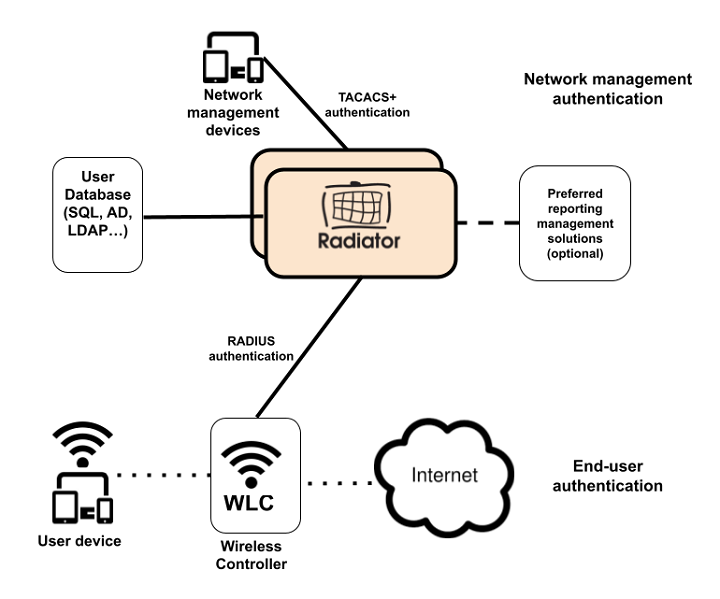
All you need is to install Radiator into your preferred platform, implement the initial configuration, and integrate Radiator to your preferred database. The use of a separate database enables your organization a secure way to store user credentials and data. Additionally, it is possible to include management and logging systems, which you may already have in use. When doing the migration, our team can provide you with assistance and experience from a wide range of use cases.

Typical Radiator set-up in a Wi-Fi authentication use case using RADIUS and TACACS+.

You do not need to worry about complicated licensing; all you need is a Radiator AAA Server Software license pack, available from one server license, two server license for high-availability, and unlimited server count license for large scale deployments. If you need an additional AAA server for a different use case within your organization, you can use a remaining available license, or upgrade your existing pack.

Would you like to know more?

With Radiator, you get direct professional technical support for configuration, deployment, and custom development. Our support packages range from basic email support to 24x7 telephone support.

Our consulting services are available to assist with migration projects. As we have had a wide range of customers with different needs migrating to Radiator, we can easily tailor a cost-effective consulting package for your needs. Thanks to our experience with similar projects, Radiator configuration can be adjusted to new environments without any extra hassle. Our customers include ISPs, enterprises, carriers, universities, public organizations, and utility companies.

If you would like to know more about Radiator, licensing options, and support, please contact our team at sales@radiatorsoftware.com

Blog post revised Feb 2nd 2022.

Monday, September 12, 2016

Utilising Radiator when evolving to 4G/LTE

One of the Radiator use cases is evolving your infrastructure for 4G/LTE features. Some of our customers already provide prepaid data plans in 3G/CDMA network but now they need to provide also 4G/LTE features for their subscribers. At the same time, being able to use the parts of the current infrastructure saves network operator’s money and time.

Radiator’s flexibility has a lot to offer for this kind of use case. You can choose any vendor for your LTE core network and Radiator will work seamlessly with it, thanks to Radiator’s multi-vendor support.

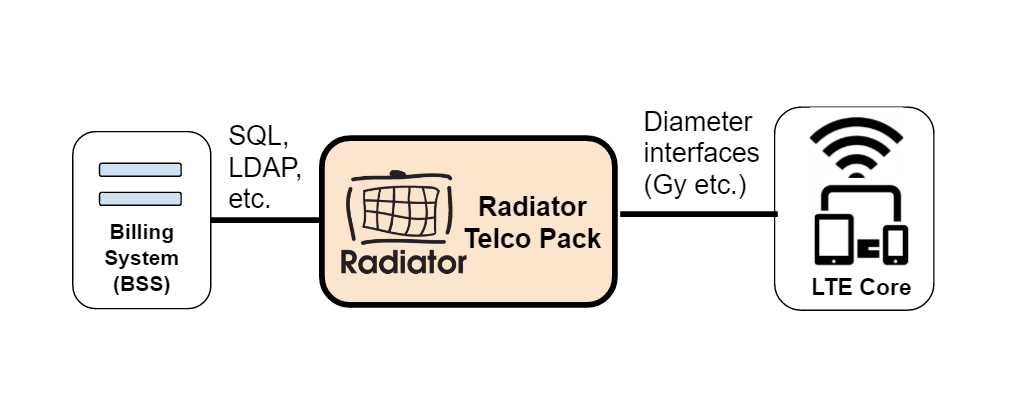
With Radiator, the same functionalities that have been implemented in 3G/CDMA network with RADIUS interfaces before, can now be implemented in 4G/LTE network with Diameter interfaces. You only need to replace your current RADIUS server with Radiator Telco Pack that provides all the needed features.

Radiator makes it also possible to use the existing customer data plans and business logic when updating for example from CDMA to LTE. For this integration, Radiator communicates with the original billing system using SQL or LDAP interfaces, among others. At the same time, Radiator uses Diameter interfaces, such as Gy, for integrating with LTE network infrastructure. See the picture below for basic layout.

Do you want to know more?

If you are interested in this kind of solution for your network, please do not hesitate to contact our sales team sales(a.t.)radiatorsoftware.com. We and our worldwide partner network are happy to provide you assistance in your project.


Friday, June 17, 2016

Radiator SIM Pack, Carrier Pack and Telco Pack releases

We are happy to announce we have now new releases of Radiator SIM Pack and Telco Pack  and also the first release (v. 1.0) of Radiator Carrier Pack, which is designed to address the needs of carriers.

Radiator Carrier Pack is targeted especially for carriers: it provides the interoperability, flexibility, and performance of Radiator, and it also includes Radiator Carrier Module. This module consists of advanced Radiator Diameter server software and Diameter relay software. These provide the platform for other Radiator carrier products: Radiator SIM Pack, Radiator Telco Pack and Radiator GBA/BSF Pack.

Initial release of Radiator Carrier Pack includes following features (and more can be found from revision history):

  • The existing and new modules are reorganised. Base components from Radiator Telco Module are now included in Radiator Carrier Module.
  • DiameterTelcoConnection now calls DiaPeer's send_reply() instead of calling send() directly. This is preferred to keep the peer state machine up to date.
  • OriginHost and OriginRealm in DiaPeerDef support special formatting.
  • Diameter initiator connections are now activated after the configuration has been loaded instead of during configuration loading.

Do you want to know more?

If you like to know more about Radiator Carrier Pack and other Radiator carrier products, please do not hesitate to contact our sales team at sales(a.t.)radiatorsoftware.com

Tuesday, May 19, 2015

Scaling and using Radiator in the cloud just became even easier


Infinite Lights, a photo by Jesus Solana (Creative Commons)


Radiator has long supported scaling with features such as server farm (FarmSize) and multiple load balancing algorithms. In the latest Radiator patches we introduce the first features in the series of new improvements aimed to make Radiator a perfect RADIUS/Diameter AAA component from private and telco clouds to public clouds such as Amazon.

As operators gradually move away from physical servers and appliances to architectures like telco clouds, network functions virtualisation (NFV) and software defined networking (SDN), the need for software components capable of scaling and communicating between each other increases. A modern AAA (authentication, authorisation, accounting) software component must have features for communication, organising cooperation (orchestration) and dynamic load balancing and that is where we started.

The current Radiator patches now include Gossip framework with an implementation built on top of Redis. Proxying and load balancing were enhanced to use Gossip for sharing information about next hop proxy reachability and unreachability. This provides fast detection and recovery from proxy failures for cooperating Radiator instances across several, even separate, servers. In addition to sharing information about network events, Gossip based duplicate cache is now available for server farm instances. This is, however, only the beginning. Moving towards Radiator 5.0, we are adding more features supporting new and future operator cloud functionalities. As always, patches will include these coming features first.

We fully recognise that we cannot do and figure out everything by ourselves and welcome your feedback. This helps us to continue developing Radiator to the component you want to use when building your services and products.


Interested in participating?


If you are an existing customer interested in these new features, please download the newest Radiator version and patches and try them. If you need help or want to give feedback, please use your existing support contract contact or send feedback via evaluation-support ( a ) open.com.au.

If you are interested in evaluating Radiator, please fill out our evaluation form and mention your interest in testing the cloud features. Our evaluation support team will contact you shortly.

Tuesday, May 12, 2015

Scalable customer data plan - customize with Radiator

Different customers have different needs. Photo by Jenny Downing (cc)
As different uses of data roaming are still expanding rapidly, telecommunications companies (telcos) and other operators need different ways to provide the best value to their customers. Price and the maximum data quota offered are not the best or the only ways to compete. Customer loyalty can be achieved with customized offers that make the customer feel that this service is provided just to him or her. Because of this, customers want to optimize their data roaming use with flexible pricing and a telco needs to address these demands.

Radiator can be used to create these kind of solutions with data plans - a monthly subscription to a service that delivers database content, real-time data, news or other information. For different kind of data plans, advanced policy and charging support is needed. In this blog Radiator is being used to create different kind of data plans for different kind of customers.

Different data plan settings for different customers

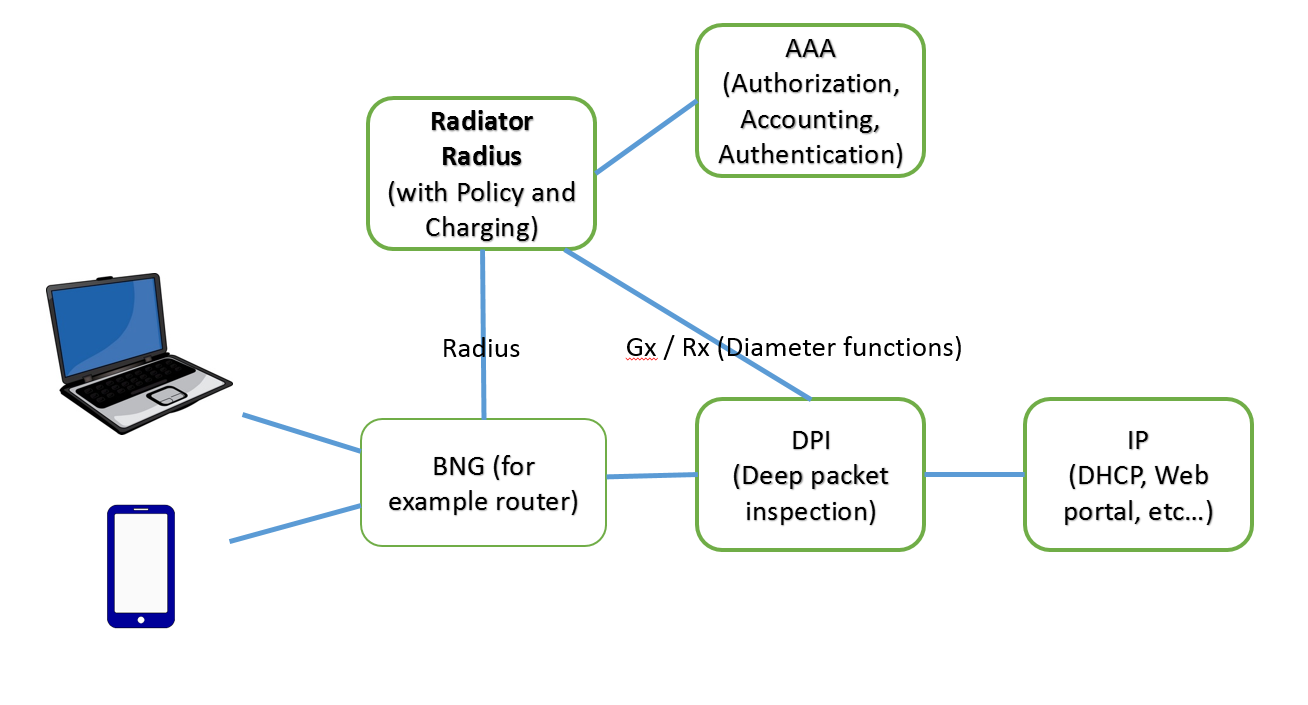
In the basic setup, the customer’s device interacts with operator’s border network gateway (BNG) - for example a router. The BNG interacts in it’s with Radiator Radius that gets customer’s data plan from operator’s other systems. This is how we have done things for our customers many times over.

However, there are more modern ways to do create data plans for customers. Another advantage that is gained with Radiator, is possibility for deep packet inspection (DPI). With DPI it is possible to create advanced data plans. Advanced data plans can for example include reserved quota for certain services (such as Spotify or others) that you can market to your customers. Another typical use for advanced data plans is dividing data quota between different SIMs - then the data can be divided between different members of family.

For telco or other service provider the advantage is scalability - differentiated data plans can be done with greater ease. See the picture below for the configuration that can be adjusted to your needs.

 
Same need in your own network?

The right solutions for you is Radiator Policy and Charging Support. Please contact our sales team sales ( a t ) radiatorsoftware.com

Wednesday, May 6, 2015

Preventing Bill Shock with Radiator

Photo by Thomas Fano
Unexpected bill shock - a huge bill accumulated from roaming - can be a nasty surprise for your customers. It is also one that can be avoided, both in domestic and in global use. One of the most known use cases is based on EU roaming regulations.

When your client uses mobile phone in other EU countries to go online, there's a limit on what an operator can charge them. The limit is based on EU regulations. To protect the client against excessive data roaming bills, the monthly cost of downloaded data on mobile device is capped, worldwide, at €50, unless something else has been agreed on. Following the EU regulations, a warning is sent when the usage reaches 80 % of the quota.

In addition to EU regulations, a system for warning and limiting data use is needed for global roaming to ensure that your clients will not have a bill shock from their worldwide data usage.

With Radiator, we have already done these kind of solutions for our operator customers who have in turn provided it for their virtual operators. In this post, we will tell you how to do it.

How to use Radiator to prevent Bill Shock

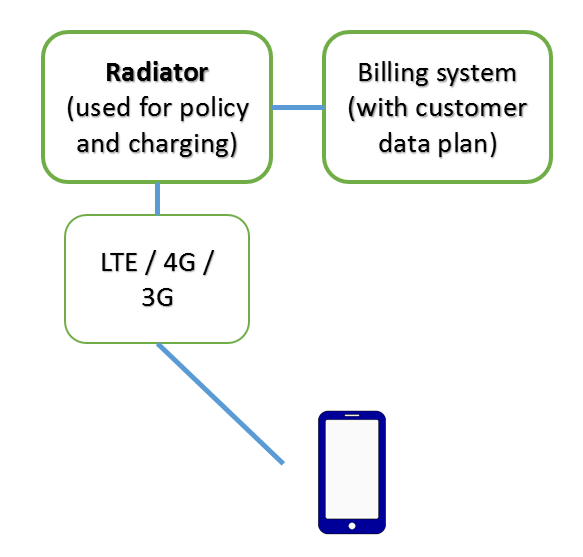
The basic layout of operator infrastructure

Radiator keeps track on the data used by the customer. To do so, Radiator interacts with the billing system where the data plans and client information is stored.

Customer's SIM is used to lookup information about the customer’s current quota usage, data plan, phone number for SMS alerts and possible other information, such as custom limit for data usage. One data plan is typically used for most of the customers, another for enterprise customers and another for customers of a virtual operator.

The client’s updated quota is then stored in the database. When the quota limit is reached, an automated SMS message is sent to the customer. After each month, the data quota is reset in the database and the usage monitoring will start from the beginning.

Customers are happy when their roaming quota is monitored reliably, and operator does not have to allocate any resources to this task. 

What do you need?

The functionality can be done with Radiator Policy and Charging Support. Contact our sales team at sales (a.t) radiatorsoftware.com.

Monday, January 26, 2015

What do Internet of Things and Industrial Internet mean?

The Internet of Things and Industrial Internet are generating a lot of buzz nowadays. Almost everything is marketed as a Internet of Things or Industrial Internet solution or somehow connected to without really describing exactly how. I wrote earlier in Arch Red's blog What Internet means for service providers, but in this Radiator Cookbook I will focus more on what is the Radiator AAA server software's relation to the Internet of Things and Industrial Internet and how you can start utilising Radiator as a part of future Internet of Things and Industrial Internet already now.

The point of Internet of Things or Industrial Internet can be abstracted like so many other things to the following familiar cycle: Measurement, Decision Making and Action.


In Internet of Things or Industrial Internet one objective is to try to monitor and measure everything from physical things to customer satisfaction and collect that data to be utilised in decision making. Decision Making of course relies on data visualisation, analysis, predictions like trends and so on. These decisions can be made manually, but one major point in Internet of Things or Industrial Internet is also automate everything, even decision making in cases where it is possible. Actually if we look at the chart above we can claim that this is not anything new, this is just automation and that is what Internet of Things and Industrial Internet mainly is -- just automation taken further and extended beyond its old borders now that we are able to measure more, store more data, make quicker analysis and decisions, as well as able to actualise the decisions by remote control and provisioning.

Radiator AAA server software can be used in every step of the cycle. Radiator can be used to collect more data from network infrastructure components, users, traffic amounts, capacity, sessions etc. In Decision Making Radiator can be used to combine data and policies from several sources to make automated intelligent decisions without having to go through manual process. This can be something like identifying badly behaving end nodes, limiting their resources or quarantining and separating them from other nodes. The data and the policies can be retrieved for example via LDAP, SQL, Diameter interfaces and orders can be communicated to network infrastructure via RADIUS and Diameter automatically. With the help of Radiator AAA server and RADIUS, Diameter and TACACS+ protocols the network infrastructure components can retrieve their updated configurations, policies and security authorisations automatically without having to do manual configuration for each network component separately.

Wednesday, August 13, 2014

Welcome to the Radiator AAA Server Cookbook


Radiator RADIUS server has been around since the early days of Internet service providers. It has and is still been developed together with our customers and partners around the world. In fact, during its lifetime, so much additional functionality and protocols have been added to Radiator, that instead of just RADIUS server, we should talk more about Radiator AAA (Authentication, Authorisation and Accounting) server. Our new extension packs, Radiator SIM Pack and Radiator Diameter Pack, extend Radiator far beyond of just RADIUS and TACACS protocol functionality. Radiator runs and scales from small embedded devices like Raspberry Pi to carrier grade network equipment and server platforms including Linux, UNIX(-like) and Windows server platforms. Radiator can be run on actual hardware or virtualised in the cloud, the major design point being that Radiator is flexible, scalable and interoperable for customers and integrators to be used everywhere in the AAA infrastructure.

The challenge in marketing Radiator is that because it can do almost everything, where should and could we start in describing what the Radiator can be used for. In trade fairs it is always possible to ask the visitors what does their organisation do and then select a suitable pitch or angle for that particular segment. Doing the same on a web page or paper brochures would require us to spend more resources to write and polish content instead of actually doing the development and real things with Radiator.

For years Radiator has been delivered with comprehensive collection of configuration examples called goodies. Our customers appreciate this and that is why we get contributions from them both in code, configurations etc. However for new customers or ones looking for solution for their problems, this functionality and applicability of Radiator is hidden knowledge. In this Radiator Cookbook, we aim to bring forward old and proven recipes as well as new and experimental ones to use Radiator for solving various customer challenges. This will not be a high frequency blog, but more like one where  you can search for recipes, solutions and inspiration how to use Radiator and where to find more information about it.

Welcome.

The Radiator Diameter Pack is now known as Radiator Service Provider Pack.