Showing posts with label Wi-Fi authentication. Show all posts

Tuesday, May 30, 2023

Radiator RADIUS for library Wi-Fi authentication

Radiator AAA server is known for its flexibility when it comes to unique use cases. This flexibility comes from the variety of supported protocols, authentication backends and logging destinations that are available in Radiator AAA server as an off-the-shelf product. This blog post will dig deeper into Radiator integration with library management systems and the 3M’s SIP2 protocol.

Library Guest Wi-Fi Authentication

Previous Radiator blog posts have gone over how network authentication works for enterprises and hotels. Today’s blog post will look at how Radiator can utilise existing library management systems to authenticate library Wi-Fi access for customers (often known as patrons). In its essence, Radiator will utilise patrons’ existing library card credentials for the authentications. Typically these credentials are used to loan and return books. This method has many benefits. First, it gives library patrons easy access to the internet without handing a common public password. Second, the internet access can be modified or disallowed based on patron status or information, for example age restrictions can be applied.

AuthBy SIP2

The key to library Wi-Fi authentication with Radiator lies on 3M™ Standard Interchange Protocol 2.0, known as the SIP2 protocol. The SIP2 protocol provides an interface between a library’s management system and library automation devices. The original use case for this protocol was and generally still is automated self-check devices for loaning and returning library books. However, this protocol can also be utilised for network authentication within the library, which is where Radiator comes in.

Radiator has a specific authentication function for this functionality. In Radiator AAA server Reference Manual Section 3.93., the function and its usage is explained. authenticates patrons based on their username and password, for example library card number and PIN code. The basic version of this configuration is very simple and Radiator’s scripts handle the communication with the library system. Essentially, In the library system’s view, Radiator is a self-service loaning device among the others.

This integration also enables further functionality. Radiator can be configured to do that if the patron has outstanding fines or fees that exceed an agreed threshold, their Wi-Fi access will be declined upon login. This is done by Radiator’s scripts and is a toggleable option within the Radiator configuration file. The access can be tied to patron status or other patron information, for example age restriction can be applied.

Want to know more?

Would you be interested in getting your library a stable, proven and affordable Wi-Fi authentication solution? Please contact us sales@radiatorsoftware.com for more information on both commercial and technical matters.

Testing the solution is also an option. We offer a 30-day evaluation licences for testing purposes and Radiator evaluation comes with thorough documentation and resources like well documented example configurations and our reference manual. To get started with a Radiator evaluation, please fill the form at our evaluation page.
Wednesday, April 6, 2022

Radiator Auth.Fi: Self-service, Passwordless Guest Access

 As a part of our Radiator Auth.Fi - Wi-Fi Authentication Service we provide self-service, passwordless guest access for Wi-Fi networks. With this service you can limit the use of your guest network to those users willing to validate their network access with email address or phone number. Compared to unauthenticated guest networks, the authenticated guest networks reduce network abuse  cases and overuse of network resources.

We have designed the guest network access validation to be easy and secure enough for the end-user without any hassle with passwords or need to reauthenticate. As the network access validation is done as a self-service, no vouchers are provided and needed reducing the work needed to support guest users in accessing the network - the authentication and authorization is connected to the user to the MAC address of the user device.

How does it work?

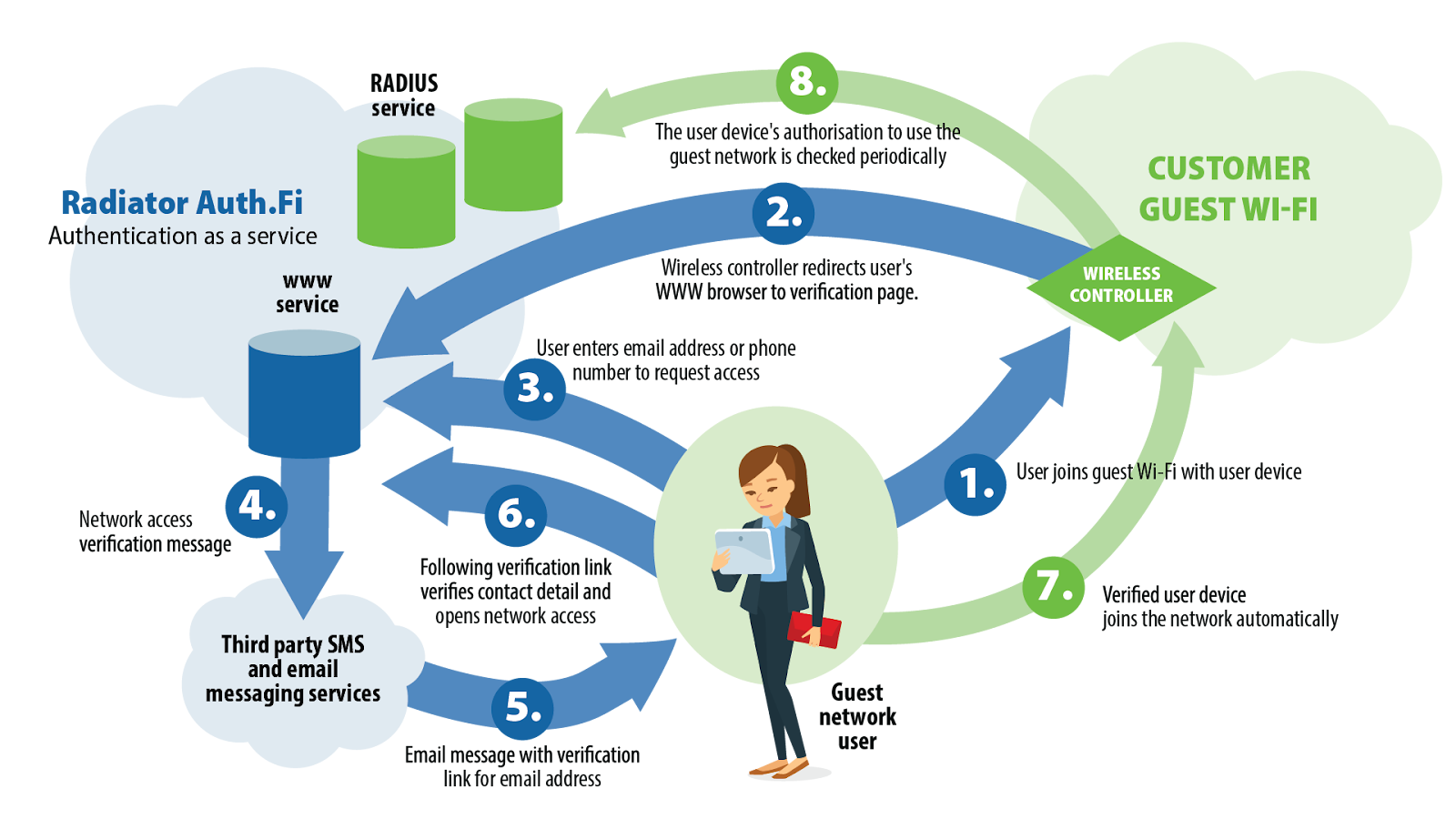
As seen from the picture below, the authentication and access process follows a few steps, after which the guest can join to the Wi-Fi network automatically - but still as an authenticated user. The steps are as follows:

  1. Guest user connects to the Wi-Fi network operated by your organization
  2. The user device of the guest user notices that authentication is needed before browsing and the user's WWW browser is redirected to the authentication page operated by Radiator Auth.Fi.
  3. Guest user chooses the method for authentication and inserts either email address or telephone number for authentication.
  4. Radiator Auth.Fi service sends the authentication verification message to the guest user to email or SMS messaging service.
  5. Email message (or optionally SMS) containing verification link is sent to the guest user 
  6. Following the verification link guest user verifies contact information and network access is authenticated with Radiator Auth.Fi
  7. Guest user can now use guest Wi-Fi network and the device joins network automatically
  8. Guest user can now use the guest Wi-Fi network for a limited time (for example 24 hours - based on your company policies) without the need for reauthentication. The authorisation of the user device to the network is checked periodically during allowed time.

Would you like to know more?

For more info about Radiator Auth.fi Wi-Fi Authentication Service, please contact our sales team at sales(a)radiatorsoftware.com or via contact form.

We are happy to discuss your use case and how Radiator Auth.fi may suit your needs. Commercially, Radiator Auth.fi is based on a flexible, pay-as-you-go subscription model that allows you scale the commercial model of the service based on your business needs. At the same time, we provide several feature options for the Radiator Auth.fi - this use case of providing guest access being one of them.

Wednesday, March 2, 2022

In-flight Connectivity with Radiator

For many of our customers we have been implementing WiFi roaming for different use cases: for example, carriers offloading traffic from their mobile network to WiFi hotspots or for providing VoWiFi (Voice over WiFi) calling to their customers.

One case for Radiator is to implement in-flight connectivity for airline carriers, providing authentication to onboard WiFi that is connected by other means (such as satellite connection) to the internet.

In this scenario, Radiator provides the necessary interfaces for WiFi roaming when subscribers of mobile operators are using their phones during the flight. With smooth WiFi roaming provided by Radiator AAA Server Software, end user devices can connect automatically to the in-flight WiFi network, and continue their use based on the roaming policy agreements between mobile operators and in-flight network operators.

Some of the benefits for this kind of solution are:

  • For the airline carrier: More value for service as a provider of smoothly connected onboard WiFi as a part of their in-flight services.
  • For the end user: Better user experience when connecting to onboard WiFi.
  • For the mobile operator: New product opportunities for mobile operator roaming with airline onboard WiFi.
  • For the onboard Wi-Fi technology provider: A flexible product with Radiator that provides connectivity to carrier networks via different interfaces.


At the same time, the solution with Radiator AAA server can of course be used in cruise ships and platforms where a smoothly run, commercial onboard WiFi is needed. 

How does it work?

On the technical side, Radiator AAA Server, combined with Radiator SIM Pack, is used to provide EAP-SIM, EAP-AKA and EAP-AKA’ authentication and connectivity to different HSS / HLR systems used by different roaming partner carriers and mobile operators. In these cases, the flexibility of Radiator helps to connect to various different systems needed via multiple interfaces.

With this configuration, in addition to handling the authentication traffic, Radiator AAA Server also proxies the accounting traffic to policy enforcement or traffic monitoring solutions that can then use it to provide access to end users, based on their data plan or subscriber profile. The following diagram shows Radiator as part of the architecture for in-flight connectivity.


Radiator provides EAP-SIM / EAP-AKA / EAP-AKA’ authentication and connecting to roaming partners HSS / HLR. 
 

Would you like to know more?

For commercial contact and more in-depth technical discussion, please do not hesitate to contact our sales team at sales(a)radiatorsotware.com . We are happy to discuss about your requirements, suitable license and configuration assistance needed for your service.


Tuesday, February 15, 2022

Upcoming webinar: Radiator Portfolio Updates - 8th March and 10th March

We are pleased to announce that we are presenting a series of live webinars about new developments in Radiator products and their use cases.

The first webinar focuses on harnessing benefits of the full Radiator product portfolio and giving brief examples from the topic list below. Each of the following sessions takes a deep-dive on real Radiator use cases, with technical insight from our experts:

  • Radiator Software news and updates in our product and services portfolio
  • Radiator Auth.fi - our new secure and easy service for Wi-Fi authentication
  • How to connect to OpenRoaming (™) roaming federation service with Radiator
  • Radiator VNF Flex - new and flexible approach to AAA VNF with Radiator
  • Using Radiator in eduroam and other roaming services 
  • Using Radiator with utility networks, such as water systems and power system management
  • Experiences from using Radiator as replacement for products nearing end-of-life
  • More coming up

The first webinar Radiator Portfolio Updates is held in parallel sessions on Tuesday 8th March 08.00-09.00 UTC and Thursday 10th March 16.00-17.00 UTC for participants from different regions to join.

Please register here to receive an invite to your preferred session. By registering you’ll also get access to the presentation recording and materials after the webinar.

Thursday, January 6, 2022

Radiator Auth.fi: easy and secure Wi-Fi Authentication for your organization

Organizations using Wi-Fi networks need an easy and secure way to provide access to the network, either to their own users or guests. At Radiator Software, we have been working with many use cases around this theme and we wanted to provide a solution where authentication features of Radiator can be used as easily as possible.

For this use, we created Radiator Auth.fi.

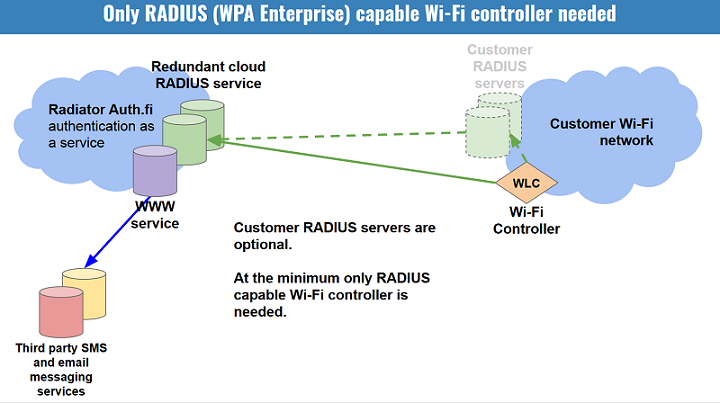
Radiator Auth.fi is a RADIUS based Wi-Fi authentication cloud service for network users and guests. It provides an easy way for employees or subcontractors to get self-service network access credentials for WPA2/WPA3 Enterprise secured network. It can also be easily deployed: you do not need new hardware, but only a few changes to the settings of your current network devices.

Radiator Auth.fi can be used globally from different locations. To accomplish this, we have set up a global cloud service that can cover multiple locations, while making sure that the service is GDPR compliant.

In addition, Radiator Auth.fi supports Wi-Fi roaming. If the visited organization and networks are part of the same roaming federation (such as eduroam or govroam) that is supported by the service, and roaming access is permitted, the roaming user’s device signs in to the network automatically and safely. It uses the settings and user credentials that are already stored in the user device.

Would you like to know more?

For more info about Radiator Auth.fi, please contact our sales team at sales(a)radiatorsoftware.com. We are happy to discuss your use case and how Radiator Auth.fi may suit your needs. Commercially, Radiator Auth.fi is based on a flexible, pay-as-you-go subscription model that allows you to scale the use of the service based on your business needs.

Friday, November 19, 2021

Companion to Radiator 4.26: SIM support 2.7 and Carrier module 1.7 released

We are very pleased to announce the release of Radiator SIM Module 2.7 and Radiator Carrier Module 1.7. This release is in companion to the most recent Radiator 4.26 version, and brings a number of fixes and enhancements to Diameter and SIGTRAN. IMSI privacy is now tested against Wireless Broadband Alliance technical specification 'IMSI Privacy Protection for Wi-Fi'. Also included are number of smaller enhancements and bug fixes.

For the full product history, please visit the Radiator SIM Module revision history and Radiator Carrier Module revision history.

Radiator packages are available to download for current licensees from the downloads page and the Radiator repository.

Access to download the latest release can be renewed by placing an online renewal order or contacting sales@radiatorsoftware.com


Radiator Carrier Pack is now known as Radiator Service Provider Pack.

Friday, October 15, 2021

Radiator provides IMSI privacy for EAP-SIM, EAP-AKA and EAP-AKA’ authentication

In many high traffic areas such as sports stadiums, shopping venues, or public transport hubs, mobile carriers may partner with the local Wi-Fi providers to improve coverage and user experience: mobile devices can be automatically connected to Wi-Fi instead of congested cellular network. Internationally, Wi-Fi roaming agreements also allow carriers to lower the cellular roaming costs. 

EAP-SIM, EAP-AKA and EAP-AKA’ are SIM-based Wi-Fi authentication methods used to achieve seamless offloading to carrier and partner Wi-Fi, with International Mobile Subscriber Identifier (IMSI) derived from the SIM card acting as a unique identifier for each user. 

On the first ever connection to such a Wi-Fi network, the mobile device communicates its permanent subscriber identity information (IMSI), which is then sent to the home operator for authentication. This identity is sent in the clear. A potential 3rd party adversary installing a Wi-Fi sniffer in the vicinity of such networks can harvest permanent identities and track users. This tracking can also be done by the venue or network owner when connecting to the Wi-Fi network. 

Because of this, mobile operating systems such as iOS15 will show the following warning when joining a Wi-Fi network without IMSI encryption: “your mobile subscriber identity will be exposed”. The similar situation can be seen from the pictures below. 

Privacy warning when authenticating to Wi-Fi network without IMSI encryption


Operators risk decreased user satisfaction for Wi-Fi offloading if transmitting IMSI in the open - it may cause users to feel their privacy is being compromised.

Radiator SIM Pack provides IMSI privacy protection 

The solution is to protect user privacy by implementing IMSI encryption for EAP-SIM, EAP-AKA and EAP-AKA’ authentication. As an operator, you can enable IMSI privacy easily: Radiator 3GPP AAA Server handles both encrypted and clear authentication requests. This means IMSI privacy can be offered to devices supporting it without affecting other users. 

Starting already from revision 2.5, Radiator SIM Pack supports IMSI encryption as specified in 3GPP S3-170116 document “Privacy Protection for EAP-AKA” (zip), and WBA’s IMSI Privacy Protection for Wi-Fi – Technical Specification. The feature is already implemented by some of our operator customers to cover their AAA server encryption. 

The latest release of Radiator SIM Pack is available for new licensees and for licensed customers with valid download access. To find out if Radiator SIM Pack suits your needs, you can contact us at sales@radiatorsoftware.com and a member of our sales team will be happy to assist you. 

You can also contact us to renew your support contract and get access to the newest release. A full history of Radiator SIM Pack releases is available on our website.

Monday, July 6, 2015

Announcement: Radiator certification testbed for easy Wi-Fi® authentication verification

Open System Consultant’s (OSC) Radiator is now available as “Radiator RADIUS virtual image for Wi-Fi Alliance® certification testbed”. With this testbed, the authorized test laboratories and vendors of user equipment can verify that their products support different authentication EAP methods - and gain Wi-Fi CERTIFIED™ status from Wi-Fi Alliance.

 The authentication methods in the testbed include EAP-TLS, EAP-TTLS, EAP-FAST, EAP-PEAP and, as new addition, EAP-pwd. The testbed is configured as a single virtual image that can be easily installed and includes all required test cases.

Radiator testbed has made this process easy. There is no need for time consuming configuration work when setting up the testbed. “We’re proud to provide this ready-to-use testbed for the benefit of the all Wi-Fi Alliance members”, says Sami Keski-Kasari, Head of Certification at OSC.

More info from our team at info( a.t. )radiatorsoftware.com


About Radiator and OSC: Open System Consultants (OSC) designs and develops innovative authentication software for internet service providers, telcos, enterprises and other organisations. OSC has customers in over 180 countries, including over 50% of top 25 mobile operators. OSC's flagship product, Radiator AAA server software is reliable, extensible, flexible, configurable and portable across any platform. It has been described as the "Swiss Army knife of RADIUS Servers". 

About Wi-Fi Alliance: Wi-Fi Alliance® is a global non-profit industry association – our members are the worldwide network of companies that brings you Wi-Fi®. The members of our collaboration forum come from across the Wi-Fi ecosystem and share a common vision of connecting everyone and everything, everywhere. Since 2000, the Wi-Fi CERTIFIED™ seal of approval designates products with proven interoperability, industry-standard security protections, and the latest technology. Wi-Fi Alliance has certified more than 25,000 products, delivering the best user experience and encouraging the expanded use of Wi-Fi products and services in new and established markets. Today, billions of Wi-Fi products carry a significant portion of the world’s data traffic in an ever-expanding variety of applications.