Showing posts with label telco. Show all posts

Monday, December 28, 2015

Implementing VoLTE supplementary services with Radiator GBA/BSF

Generic Bootstrapping Architecture (GBA) is a technology that enables the authentication of a user. This authentication is possible if the user owns a valid identity on an HSS (Home Subscriber Server). GBA is standardised at the 3GPP. The user authentication is instantiated by a shared secret, for example, a SIM card inside the mobile phone and the other is on the HSS.

With GBA, it is possible to provide VoLTE Supplementary Services, for example, Call Forwarding in VoLTE. Call Forwarding is an example of use case that cannot be pre-configured for all the subscribers because users want to configure their own forwarding number. With Radiator GBA/BSF module, this is possible to done in your VoLTE network – without the need to drop the user from VoLTE to other network.

How this is done with Radiator?

One of our customers had a need for VoLTE Supplementary Services in their network, and as a part of product development, a new Radiator GBA/BSF module was introduced to meet their needs.
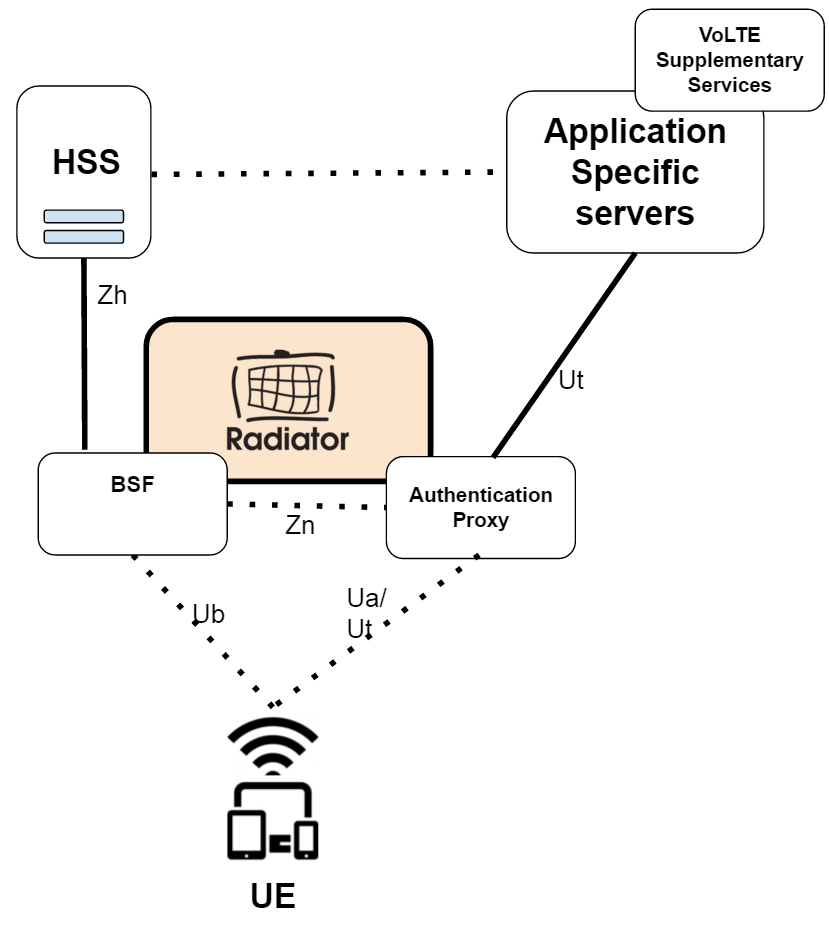
GBA_AP.png
One example architecture when using Radiator GBA/BSF module for VoLTE Supplementary Services


As it is shown in picture above, Radiator GBA/BSF module will work as a authentication proxy between the end-user UE and HSS. It will authenticate user requests, and also separate the authentication procedure and the Application Specific server (AS) specific application logic to different logical entities – such as VoLTE Supplementary Services.

After the authentication procedure has been completed, Radiator GBA/BSF module assumes the role of a reverse proxy, i.e. the AP forwards HTTP requests originating from the UE to the correct AS, and returns corresponding HTTP responses from the AS to the originating UE.

Need for VoLTE Supplementary Services in your own network?

In case you need VoLTE Supplementary Services, such as Call Forwarding, in your own network, please do not hesitate to contact our team at sales(a.t.)radiatorsoftware.com. Our team of experts is happy to assist with your project.

Tuesday, June 9, 2015

Radiator logging features - have a better understanding of your network

A proper logbook keeps the world in order. Photo by vxla.

As networks are the most business critical components of telco and ISP business, it is important to know what is happening on them. For this the network needs AAA and SIEM (Security information and event management) services. The SIEM services are often provided by different vendors with different requirements for message format. For example, some use CEF while the others can accept free format text. We are proud that Radiator already provides interoperability that our customers can rely on. We also welcome your requests for new features.

Radiator 4.14 introduces LogFormatHook that provides a new way to handle logs. The main use of LogFormatHook is to create Radiator logs in different formats such as JSON and CEF. After this the formatted log message can be transmitted to an external log server or SIEM system for further processing, visualisation and archiving. Examples of these servers and systems are Splunk, Elasticsearch and RSA enVision and Security Analytics.

Especially with SIEM systems this functionality provides Radiator users many opportunities for log analysis. The SIEM systems can process log data for forensic analysis, compliance, dashboards and alerting - everything you or your customers need to know about status of their network.

Considering updates to your logging configuration?

If you have a network environment that needs this kind of interoperability with their log or SIEM systems, please contact our sales team at sales (a.t.) radiatorsoftware.com . Also, if you have questions about interoperability concerning Radiator or some other AAA server solution - we just may have a solution for you.