Thursday, September 29, 2016

Make your Radiator log data searchable, part 2

This is the second part of blog series that helps you to use the log data that Radiator generates.

In the first part of blog series, we configured Radiator to export data in JSON format. This part shows some basic examples about utilising that data.

The setup introduced in blog series part 1 is running and it produces log data in JSON format. The JSON data is forwarded to an analysis tool. In this case, we use Elastic Stack and its visualisation tool Kibana for analysing the sample data. For more information about Elastic Stack, see the Elastic Stack website, or an open source fork of Elastic Stack, OpenSearch. Configuring the data forwarding depends on the chosen tool and it is not discussed in this blog post.

This image shows how the log data is processed when using Elastic Stack for analysing:

radpwtst to Elastic stack.png

radpwtst tool, which is included in Radiator distribution, is used as a RADIUS client. Thus, it authenticates via RADIUS and Radiator logs authentication attempts as entries to authlog.json file. Here is a sample of one authentication entry as shown in the JSON file:


{"nas_port":"1234","source_host":"osc-dev-3","time":"1463404359","type":"authentication","timestamp":"2016-05-16T16:12:39Z","nas_identifier":"203.63.154.1","nas_ip_address":"203.63.154.1","calling_station_id":"987654321","result":"accept","username":"mikem","called_station_id":"123456789","trace_id":"43efcbe2"}


The name-value pairs are not ordered in any way so they are hard to read as such. To get a better idea of the data, it must be parsed. One option is to use configuration variable for the plaintext output, it is feasible to use, at least in the testing phase. This helps to verify that the data is correctly interpreted by Elastic Stack.

Visualising log data with Kibana

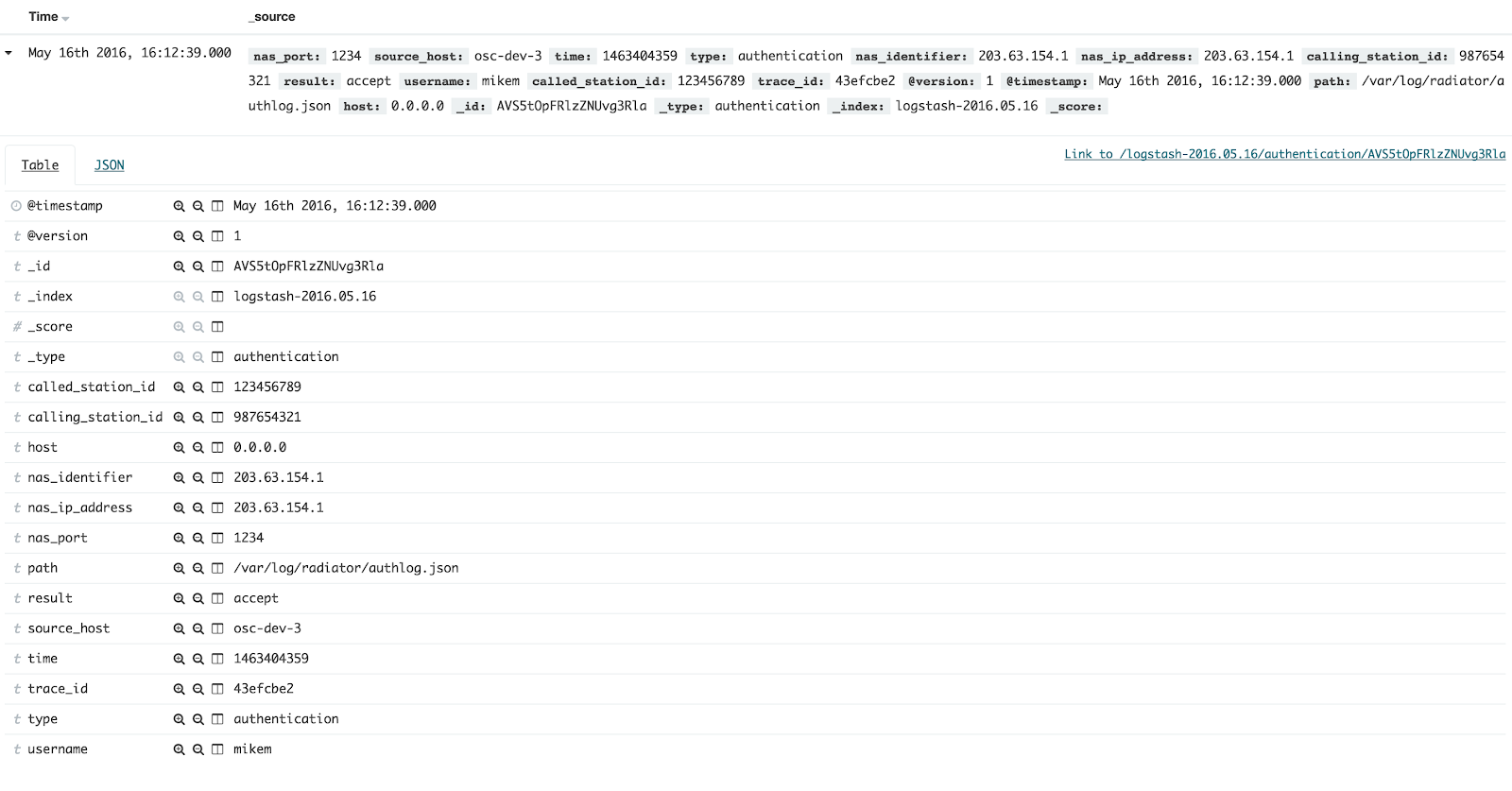
Elastic Stack parses the data so we can explore the contents in Kibana. Part of our sample data looks like this in Kibana:


By clicking each entry open, we can verify that all name-value pairs are distinguished. By default, each name-value pair is indexed and searchable, and if you add new fields to the JSON data, Elastic Stack indexes them automatically. They are parsed and usable in your searches without need for other modifications. This enables searching of wide variety of name-value pairs and their combinations.


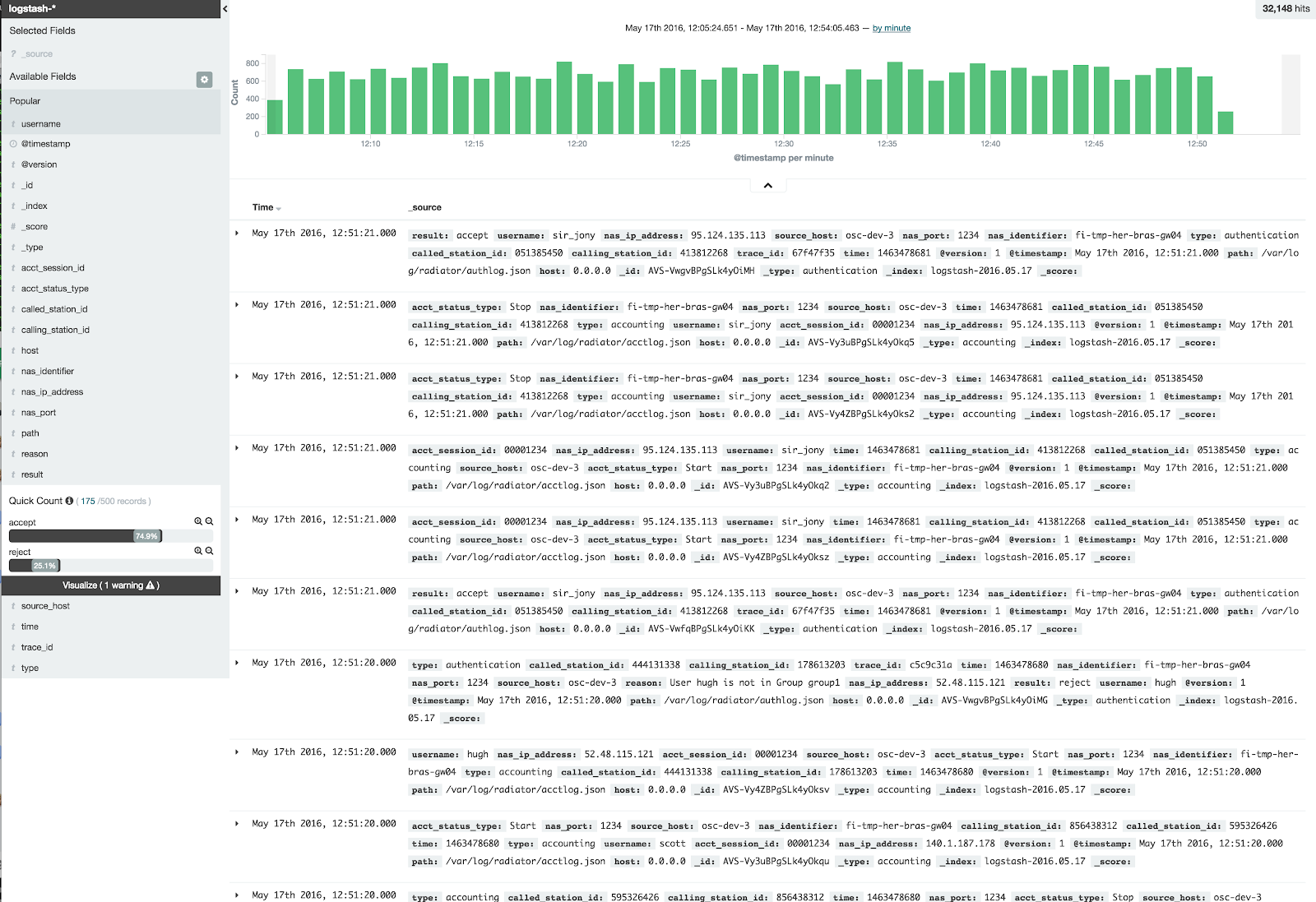
Kibana shows the amount of entries in each time window. By filtering everything else but authentication-related entries, we see trends in amount of authentication attempts.


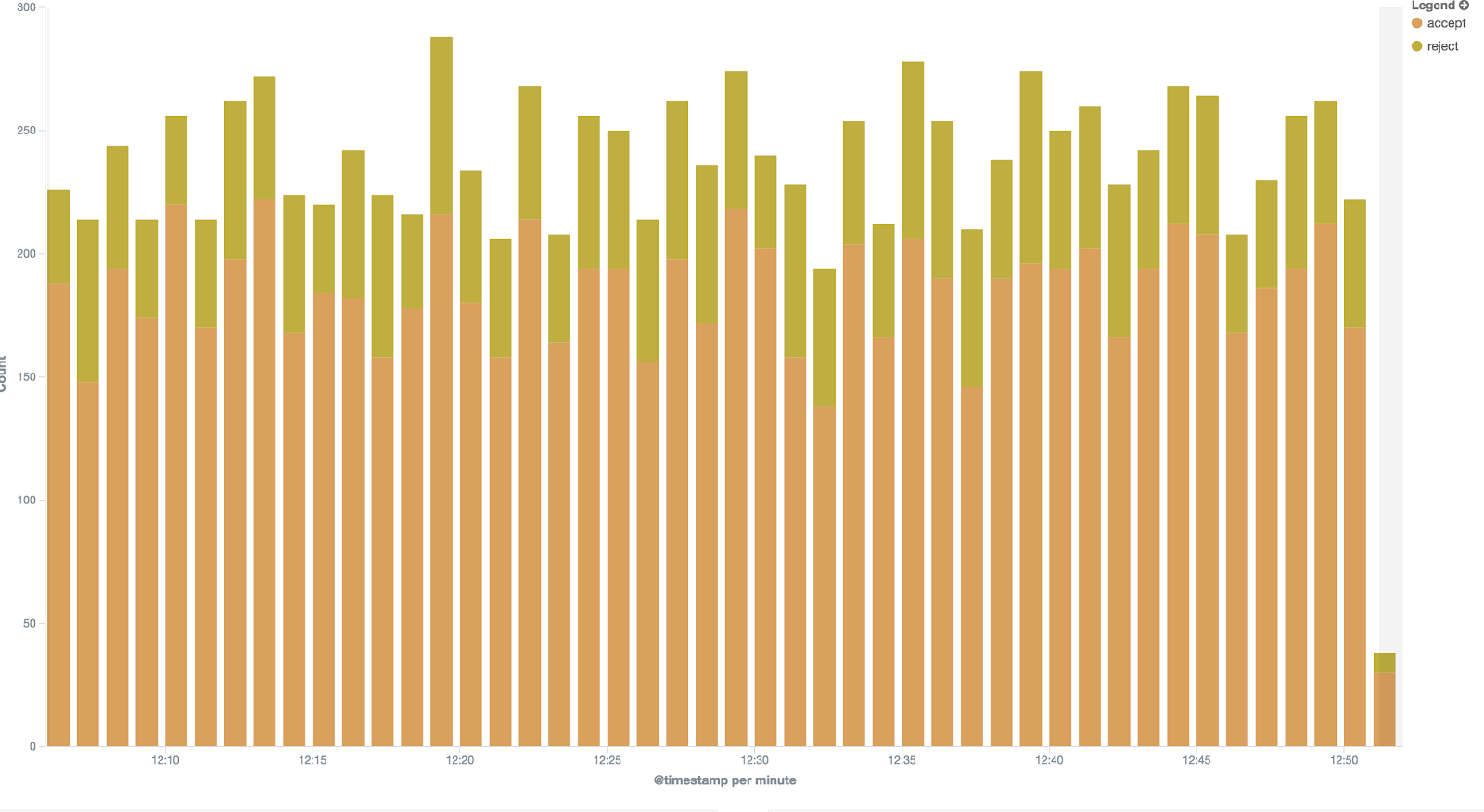
Similarly, we can create visualisation of access/reject rate within a certain time frame.


Do you want to know more?

There will be examples of more detailed JSON use cases in the blog. If you have questions, contact Radiator team at sales(a.t.)radiatorsoftware.com – we are happy to help you to have more benefits of your log data.

Monday, September 12, 2016

Utilising Radiator when evolving to 4G/LTE

One of the Radiator use cases is evolving your infrastructure for 4G/LTE features. Some of our customers already provide prepaid data plans in 3G/CDMA network but now they need to provide also 4G/LTE features for their subscribers. At the same time, being able to use the parts of the current infrastructure saves network operator’s money and time.

Radiator’s flexibility has a lot to offer for this kind of use case. You can choose any vendor for your LTE core network and Radiator will work seamlessly with it, thanks to Radiator’s multi-vendor support.

With Radiator, the same functionalities that have been implemented in 3G/CDMA network with RADIUS interfaces before, can now be implemented in 4G/LTE network with Diameter interfaces. You only need to replace your current RADIUS server with Radiator Telco Pack that provides all the needed features.

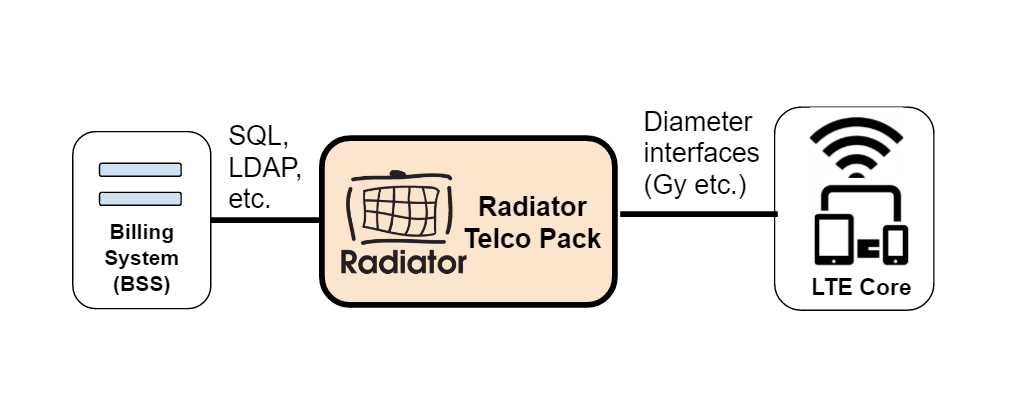
Radiator makes it also possible to use the existing customer data plans and business logic when updating for example from CDMA to LTE. For this integration, Radiator communicates with the original billing system using SQL or LDAP interfaces, among others. At the same time, Radiator uses Diameter interfaces, such as Gy, for integrating with LTE network infrastructure. See the picture below for basic layout.

Do you want to know more?

If you are interested in this kind of solution for your network, please do not hesitate to contact our sales team sales(a.t.)radiatorsoftware.com. We and our worldwide partner network are happy to provide you assistance in your project.


Tuesday, August 2, 2016

Secure your network and services with Radiator two-factor authentication

Modern services all around the Internet offer different two-factor authentication solutions. They provide stronger security than using only username and password. Two-factor authentication requires a combination of something the user knows and something the user possesses. One common combination is the username and PIN or password with a physical token, such as a specific device, smart card, or mobile phone. The two-factor secured service may range from a web service to a network device to a remote VPN (Virtual Private Network) access – wherever stronger security is needed.

Figure 1: Radiator based two-factor authentication and authorisation architecture

Radiator AAA Server Software provides flexible, interoperable, and scalable two-factor AAA (Authentication, Accounting, and Authorisation) service for any device or service, which can use RADIUS, TACACS, or TACACS+ interface for AAA. The VPN devices can authenticate remote employees, the network devices can authorise administrators, and the web services can identify the users with secure two-factor authentication. All you need is Radiator-based two-factor AAA service and a free mobile phone app, such as Google Authenticator, Microsoft Authenticator, or some other OTP/TOTP/HOTP app. The authenticator app is paired with Radiator two-factor AAA service and particular user credentials, and two-factor authentication are ready to be used.

Another major benefit of using Radiator is its legendary interoperability. Radiator can combine complementary AAA information and functions from Active Directory, LDAP, and even 3rd party two-factor services, such as RSA SecurID, YubiKey, Duo Security, and Vasco Digipass. It can check existence and validity of a user from Active Directory, retrieve a proper VPN group, perform two-factor authentication using TOTP (Time-based One-time Password Algorithm), and then combine the results to a RADIUS authentication and authorisation response, which is sent back to a Cisco ASA VPN device.

Radiator can also extend the functionalities of 3rd party two-factor authentication services by translating and complementing AAA interactions between services and devices. For example, Radiator combines fine-grained TACACS(+)- or RADIUS-based network device configuration authorisation with existing user directories and two-factor authentication. The two-factor authentication data may be retrieved from Radiator itself or some 3rd party service. With the help of Radiator’s extendable two-factor modules, Radiator also supports SMS transfer of one-time-passwords, when using tokens or authenticator app is not feasible.

Radiator and its two-factor authentication functionalities have already been deployed in several different environments such as:
  • Fortune 250 company uses Radiator for two-factor authentication of their global VPN network.
  • IT departments of world’s two top universities provide VPN service for their employees, partners, and students utilising Radiator’s capability to combine Duo Security two-factor authentication service to additional LDAP directory checks.
  • Nordic operator provides multi-function (RSA SecurID, SMS) two-factor authentication service to their enterprise customers.

Would you like to know more?

Contact our team at info@open.com.au to set up a meeting, where we can discuss how Radiator could help you in securing access to your services or network with two-factor authentication.

Monday, July 18, 2016

Flexible M2M/IoT service with Radiator and Private APN

M2M (Machine to Machine) communications, IoT (Internet of Things), and Industrial Internet are constantly bringing new connected devices, things, to the Internet. Operators and other companies already use Radiator AAA Server Software to create M2M, IoT, and Industrial Internet services to customers. Using Radiator with Private APN (access point name) is an important use case.

Figure 1: Radiator RADIUS server and Private APN service architecture

Most mobile operators provide, in addition to their own APNs, also a Private APN service for companies interested of separating their data traffic from operators’ generic subscriptions. The Private APN service utilises operator’s SIM cards for radio network access, but separates the data traffic in operator’s GGSN (gateway GPRS support node) by the access point name (e.g. internet.company instead of operator’s own access point name). These separate private access points may have their own parameters for authentication, accounting, IP networks, IP address allocation, connection parameters, traffic accounting, priorities, and other functionalities. Depending on the GGSN capabilities, it is possible to move some of these functionalities and information to a separate RADIUS service, which is provided either by the operator or company utilising the Private APN.

With the Private APN and Radiator AAA Server Software as a RADIUS service, our customers have successfully deployed M2M, IoT, and Industrial Internet solutions. Some examples are:
  • Fixed IPv4 and IPv6 address allocation for mobile operator M2M/IoT service based on MSISDN (phone number) with the option of returning any GGSN-supported subscription parameters from RADIUS to GGSN
  • Ensuring that the Australian state-wide network of water measurement devices are active and sending measurement data, and working as AAA service for VPN connection authentication for devices
  • Tracking truck locations, and authenticating, accounting, and authorising GPS tracking devices for fleet tracking service operating across several operators and European countries

Would you like to know more?

This use case is one of the many, where Radiator can be used to provide additional and complementary functionality to mobile network and Internet of Things/Industrial Internet solutions. Contact our team at sales(a.t.)radiatorsoftware.com to set up a meeting, where we can discuss how Radiator could help you in building and deploying mobile network or IoT/Industrial Internet services and solutions.

Friday, June 17, 2016

Radiator SIM Pack, Carrier Pack and Telco Pack releases

We are happy to announce we have now new releases of Radiator SIM Pack and Telco Pack  and also the first release (v. 1.0) of Radiator Carrier Pack, which is designed to address the needs of carriers.

Radiator Carrier Pack is targeted especially for carriers: it provides the interoperability, flexibility, and performance of Radiator, and it also includes Radiator Carrier Module. This module consists of advanced Radiator Diameter server software and Diameter relay software. These provide the platform for other Radiator carrier products: Radiator SIM Pack, Radiator Telco Pack and Radiator GBA/BSF Pack.

Initial release of Radiator Carrier Pack includes following features (and more can be found from revision history):

  • The existing and new modules are reorganised. Base components from Radiator Telco Module are now included in Radiator Carrier Module.
  • DiameterTelcoConnection now calls DiaPeer's send_reply() instead of calling send() directly. This is preferred to keep the peer state machine up to date.
  • OriginHost and OriginRealm in DiaPeerDef support special formatting.
  • Diameter initiator connections are now activated after the configuration has been loaded instead of during configuration loading.

Do you want to know more?

If you like to know more about Radiator Carrier Pack and other Radiator carrier products, please do not hesitate to contact our sales team at sales(a.t.)radiatorsoftware.com